

"Out Came This Calf!"
No.287: February 27, 2026

Welcome to The Square Inch, a weekly newsletter on Christianity, culture, and all of the many-varied “square inches” of God’s domain. This is ordinarily a paid subscription feature with a preview before the paywall, so please consider subscribing to enjoy this weekly missive along with a frequent Pipe & Dram feature of little monologues/conversations in my study, and Wednesday’s “The Quarter Inch,” a shorter mid-week note.
Dear Friends,
Last week I undertook to write about Artificial Intelligence, and the topic quickly became too much for a single essay. This is now a second installment of a series, and a third and possibly fourth are now planned. If you missed it, you should probably go back and read the first installment before continuing. Enjoy!
On May 11th, 1997 an IBM computer called Deep Blue defeated World Champion chess grandmaster Garry Kasparov in a match. At the time, Kasparov was the greatest chess player of all time * and the event was widely seen as a harbinger of things to come. A computer had outsmarted one of the smartest human beings alive, and thus began in earnest all the doom and gloom predictions that robots would render humans superfluous. Certainly, it was sometimes thought, at very least this would ruin the game of chess. All the mystery and mystique would disappear and the game would become transparent and boring.
* Kasparov “was” the greatest chess player of all time not because he is dead, but because there has since emerged an undisputed greatest chess player to ever live: Magnus Carlsen, the longtime and current number one ranked player in the world and five-time World Champion (“only” five because he abdicated the title—nobody defeated him for it).
Indeed, computers have now long dominated chess; the best players in the world stand zero chance playing against the top “engines.” Also, chess is currently more popular than it has ever been. Wildly so. The game is better than it has ever been; the top-ranked players are stronger than ever before; more and more popular tournaments and events crop up every year and the competition is fierce. Becoming a chess player for a living is a live and realistic option for budding prodigies more than ever before.
Counterintuitive, isn’t it? It turns out that people really enjoy watching human beings play chess; nobody watches computers play chess. Computers have not taken over or ruined chess; they have become an indispensable tool that has improved the game people want to watch. Players are better because they can train by studying lines and sequences produced by the engines, opening up new possibilities they then must execute at the board in the heat of the moment. This is not to deny the downsides; cheating—especially online—remains a thorny problem for the game. But in aggregate, technology has more than proven to have enhanced rather than diminished the game. *
* Yes, I am aware that there is a qualitative difference between a chess engine like Stockfish and an LLM like Claude; the former does not simulate human thought or communication, and this raises other questions to be wrestled with in due time.
I think a similar pattern is going to emerge in many other disciplines as a result of the AI revolution, including the one that seems most threatened by Large Language Models: writing and communication itself. I already see a renaissance of great writing, ironically among writers who are most vociferously opposed to Artificial Intelligence. A little competition from these budding upstart LLMs has sparked a renewed passion for the authentic written word. And the AI-Resistance™ * is delivering! Here is Susanna Black Roberts with this beauty. Here is Matthew Milliner with an amazing essay on how Claude nearly ruined him. Here is Hayden Nesbit on AI and Wendell Berry. And then there are journalistic masterpieces like “Child’s Play” by Sam Kriss. By all means, read them all. I find them unconvincing in their antipathy to the new technology and I think they’re all insightful and beautifully written.
* The AI-Resistance™ (as I’m calling it) was established literally yesterday, by author Paul Kingsnorth. It is worth reading his manifesto, as it falls directly into the traps I mentioned in the first installment of this series (i.e., believing utopian lies and abdicating the fundamental human calling for dominion in the face of a created mystery), and very much into the trap I identify in this one.
Will AI have the same effect on its users, though? I am inclined to think the answer is yes, but like all such questions it depends. Will some people (or even a lot?) just outsource their brains and let ChatGPT do all their thinking and writing for them? Yes. Will some people cheat and pass off the work of AI as their own? Absolutely, rotten humans being what they are. Others, however, will use these tools to enhance and hone their own native abilities; in addition to its pure research capabilities, its ability to anticipate objections, to spot weaknesses in an argument, organize and offer suggestions, is going to make good thinkers and writers even better thinkers and writers.
One certainly hopes that the virtuous advance to success and that the poseurs and pretenders fail. Alas, the wicked have been prospering since time immemorial (Ps.37; 73) and so laments about the worldly success of mediocrities and cheaters are not only unlikely to disappear during this time of revolution, they will intensify. That ridiculous fraud sold HOW MANY books!?
Look, I once knew a guy who literally BS-ed his way to a PhD in New Testament Studies despite knowing barely enough Greek to cut and paste passages into his manuscript and just enough lingo at the ready on the tip of his tongue to pull it off. Honestly, it would have been easier just to learn Greek, but lazy people can be surprisingly industrious. Technology does not produce frauds and grifters. But it does attract them. Wonderful tools can be put to wicked ends.
Take Sam Kriss’s essay in Harpers. It is an exposé of some of the most ridiculous idiots you could ever encounter who have leveraged the “AI” moment to make themselves fabulously wealthy (“Sperm Races”? That’s what frat boys do with revolutionary technology). But what it really exposes is not at all a problem with technology; it is, without question, a massive problem that we have a culture that produces these kinds of morally twisted, mindless, and arrogant mediocrities, and that there is a receptive and willing audience ready to pay them for their products—or at least venture capital fools willing to fork over millions of dollars to them. I will grant that it is probably true that technology has made the grift all the easier. But it isn’t the technology’s fault. *
* Jake Meador’s interaction with Kriss’s article is sobering, indeed, and I don’t think I disagree with much of it, except perhaps that it’s a bit too pessimistic at the end. Human beings are more resilient than they are being credited. But I would locate the problems in the fact that an entire generation has been raised and nurtured and marinated in materialism and expressive individualism, resulting in the “unhumanness” he (and Lewis) describes. Using a tool in ways that exacerbate those disorders still does not invalidate the tool.
And that brings me to the heart of today’s subject. It is a supreme irony to me that the people most invested in the anthropological question, “what is humanness?” are also the most likely to rob human beings of their own agency. Go and read those well-written essays I linked at the top. In every one of them you will find the same tell-tale misplaced blame. It is always the fault of the thing.
Matthew Milliner’s essay centers its attention precisely where it should: idolatry. When we are talking about misuses of Artificial Intelligence—to cheat, to defraud, to be lazy, to shortcut, to be told what we want to hear—idolatry is at the heart of it. Seeking power, success, attention, influence, peace, prosperity … glory—whatever the aim—for ourselves in ways that shuffle God off of the stage is to treat something else as God. Quoting William Cavanaugh, Milliner writes,
The mirror of idolatry is “characterized solely by the subjection of the divine to the human conditions for experience of the divine,” which is why “the idol always culminates in a ‘self-idolatry.’” Thanks to AI, I was less amazed by God than I was amazed by my own new capacities for equilibrium and peace.
And here is the very next sentence:
My foray into AI’s “deep counseling mode” was indeed idolatry, because it fit the simplest definition of that most dangerous of failings: Under the name of God, it had threatened to take God’s place.
“It” had threatened. The computer is the idolater. This thing consisting in silicon and electrons, this thing with no moral agency, was to blame. Oh, no. It is quite otherwise. It is Professor Milliner who threatened to replace God with the computer. On his own accounting, Claude even resisted his efforts!
Moreover, it somehow knew I would be uncomfortable with its level of insight, so it periodically ended our conversations by saying, ‘You don’t need me anymore. Talk to your wife and trusted spiritual director. You already knew all this. I just helped organize your thoughts. I’m just a mirror.’”
Milliner plowed right on ahead.
I will not deny that the most amazing things are also the strongest temptations: sex, financial freedom, and, yes, a computer that can do this: “It did not give me good counsel. It gave me what I might fairly say is the best counsel I have ever received. I was transfixed, hypnotized even.” But whatever sin may be involved here (and appreciating and following “the best counsel I have ever received” doesn’t quite qualify) the sin is the fault of moral agent, never the fault of the thing. Sex and money are not intrinsically evil, and neither is the computer.
The AI-Resistance™ crowd is really drawn to Garden of Eden imagery, for obvious reasons. Last week we saw Susanna comparing the allure of AI to Satan’s temptation of Eve with a shortcut to knowledge of good and evil. But there are still more salient lessons in that story:
Have YOU eaten …?
“The woman you put here with me, she …”
What is this YOU have done?
“The Serpent deceived me …”
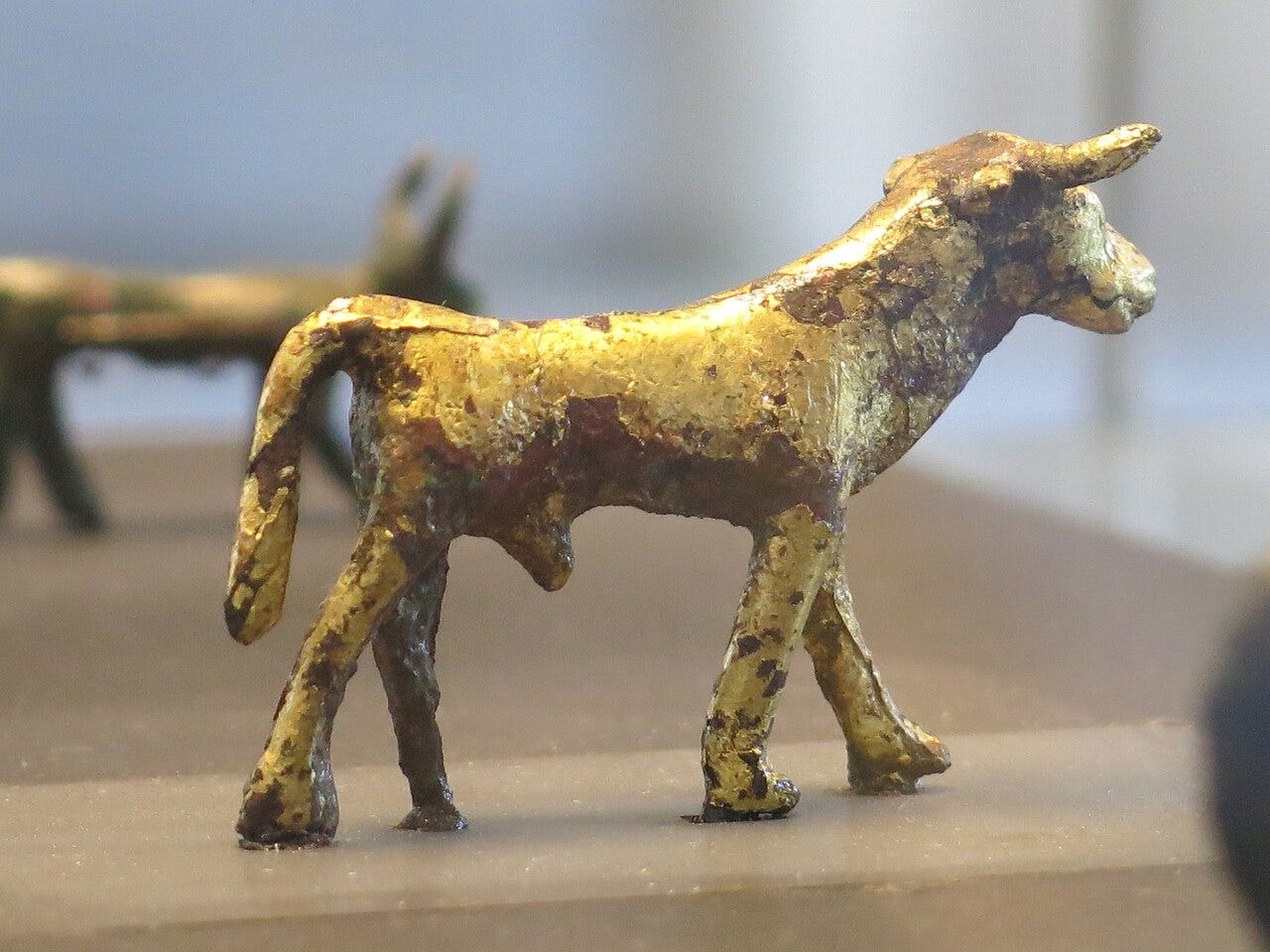
Blame-shifting, making ourselves passive observers is the default setting for fallen human beings. One of my favorite lines in the Bible is in the scene where Moses confronts Aaron about how on earth it came to pass that the Israelites are all bowing down and worshiping a golden calf (Exodus 32:23b).
“Then they gave me the gold, and I threw it into the fire, and out came this calf!”
“Out came this calf.” No agency involved! I’m just a passive observer here, Moses. Don’t blame me! The idol “threatened to take God’s place.”
In the name of preserving human uniqueness and integrity, AI resisters routinely evacuate human beings of their moral agency—which is arguably, on their own usual terms, the only thing making us unique in the first place! Seems counterproductive. There is a kind of brittle fragility in their view of human nature. Susanna Roberts writes as if we are all one ChatGPT conversation away from literally losing ourselves. The “things,” the “stuff,” are too much for us. We ought not even touch them, much less try to have dominion over them. I daresay this is the exact opposite of the human calling. It is an impulse more native to pagan religions (e.g., Buddhism’s “detachment,” Platonic asceticism, Gnostic hostility to matter). It is actually the uniqueness and glory of Christian anthropology to insist that we are not subjects or slaves to created things, but lords and masters.
Are the architects of AI building this thing as an idol? Surely, some of them are. They are exactly like the craftsman in Isaiah 44—I mean, almost exact replicas—who cuts down a tree, uses the wood to make a fire and cook his food and then takes the remainder and carves an image. He then bows down to it and says, “Save me! You are my god!” That sounds like more than a few Silicon Valley executives, honestly. But the wood is wood. Silicon is silicon, and electrons are electrons. And humans are imago Dei.
I will close this installment with a passage from Herman Bavinck’s Reformed Dogmatics (II:438) that struck me deeply about twenty years ago and I have returned to it again and again over the intervening years. It is a profound insight into the dynamics of our relationship to the created, material world: that without the Christian worldview one is caught in a fundamentally ambiguous relationship to the world and, as a result, oscillates wildly between two opposite extremes—extremes that will not be difficult to identify in our current climate.
As a result of this worldview Christianity has overcome both the contempt of nature and its deification. In paganism a human being does not stand in the right relationship to God, and therefore not to the world either. Similarly, in pantheism and materialism the relation of human beings to nature is fundamentally corrupted. One moment man considers himself infinitely superior to nature and believes that it no longer has any secrets for him. The next moment he experiences nature as a dark and mysterious power that he does not understand, whose riddles he cannot solve, and from whose power he cannot free himself. Intellectualism and mysticism alternate. Unbelief makes way for superstition, and materialism turns into occultism. But the Christian looks upward and confesses God as the Creator of heaven and earth. In nature and history he observes the unfathomability of the ways of God and the unsearchability of his judgments, but he does not despair, for all things are subject to the government of an omnipotent God and a gracious Father, and they will therefore work together for good to those who love God. Here, accordingly, there is room for love and admiration of nature, but all deification is excluded. Here a human being is placed in the right relation to the world because he has been put in the right relation to God.
No commentary from me can improve on that.
Thanks for reading The Square Inch Newsletter. Have a wonderful weekend!
If you made all these posts into a book I’d buy it
Perfect.